

Upcoming BeeBlitz, Jean Ponzi interviews Nina, weird carpenter bee guts, pond-o-rama, more backyard science!
Annual Pollinator Week BeeBlitz at Forest Park
You are cordially invited to our annual beeblitz on Friday, June 23rd at 2pm! We will meet at the Forest Park Visitor and Education Center (5595 Grand Dr, St. Louis, MO 63112) and meander to native plantings in the park. Come nerd out with us in a bee diversity “hot spot” for the region. We have found some rarer taxa, such as the southern plains bumble bee (B. fraternus) and blood bees (Sphecodes sp.) during our beeblitzes. Maybe we’ll find something new this year! This event is a great chance to meet other Shutterbee participants, practice your bee photography, ask any questions you have, and generally be in community with fellow nature enthusiasts. We hope you can make it!
Jean Ponzi interviews Nina for the EarthWorms Podcast
Jean Ponzi, science communicator extraordinaire, has been sharing conservation stories through her EarthWorms Podcast for 32 years. This year, she interviewed Nina about the Shutterbee project! Take a listen to learn more about the goals of the project and where we stand as of the end of our third year and headed into our fourth.
The Weird Guts of Carpenter Bees
A recent study found that carpenter bees (genus Xylocopa), which are generally considered to be solitary bees, have a very distinct gut microbiome. Notably, it is unusual because it is similar to (but still distinct from) that of eusocial bees, such as honeybees and bumblebees, in that it is 1) made of common bacterial strains and 2) shared between individuals.
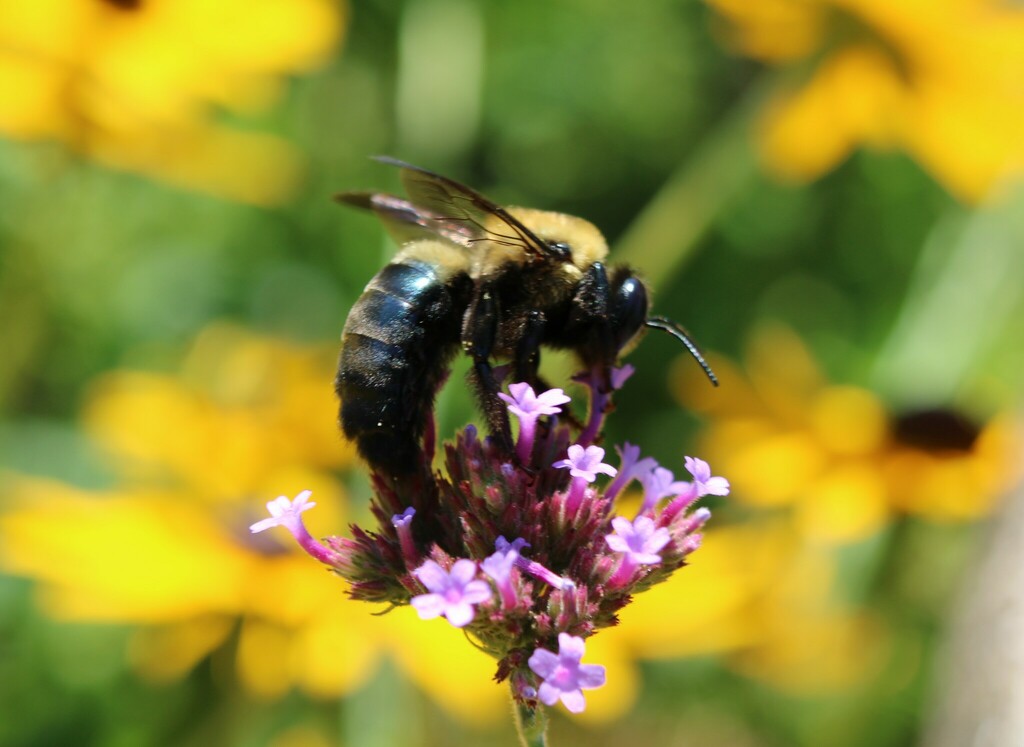
Why do we care about bee bellies (besides that they can be fuzzy and adorable)? In short, this development sheds light on bee behaviors across taxa:
Firstly, gut microbiota of eusocial bees are actively shared (and thus incredibly consistent) among nest members to aid in digestion and pathogen defense. Because these bees live in close contact with one another, the risk of disease transmission is high. The common bacterial strains act as an extension of each worker’s immune system that creates a sort-of “herd protection” against common parasites and other illnesses.

In contrast, most solitary bee species tend to have incredible variation in their microbiomes based on environmental factors. Solitary bees, unsurprisingly, do not live in close-quarters like their eusocial cousins, so both disease transmission and a need for a communal defense are low. Why, then, might carpenter bees have such a conserved microbiota?
The answer may lie in part with how carpenter bees nest. Though broadly solitary by default, these woodworkers often share nesting sites with members of the same species, so proximity increases. In theory, this closeness in itself could increase the need for pathogen resistance and perhaps facilitate a shared gut microbiota through accidental exposure. Parasociality, however, is not unique to carpenter bees in the slightest – while the similarity to eusocial bee microbiomes is distinct (as far as we know now) among solitary and parasocial bees.
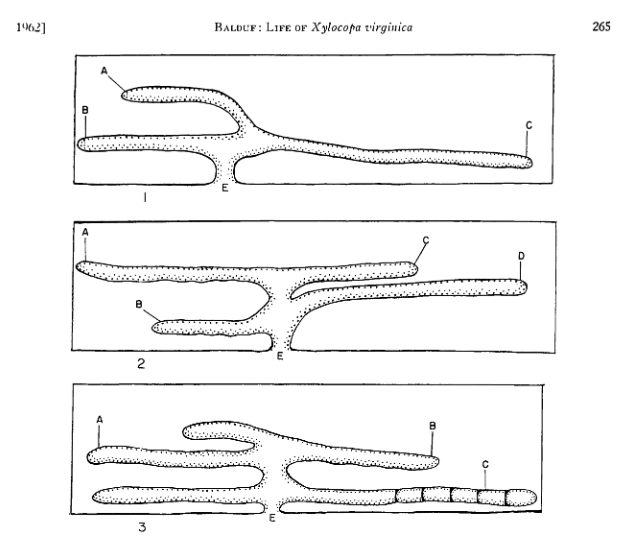
What might truly set carpenter bees apart is… their carpentry! Because these big-bodied bees must chew through a decent bit of wood to accommodate their large offspring, carving out nests takes quite a bit of energy and effort! As a result, pre-established nests are a hot commodity, and females may opt to nest together. In communal nesting sites, younger females often inherit established nests from older females after waiting periods of up to a year.
Carpenter bees, then, live in close quarters for extended periods of time, and this is why they might transmit their gut bacteria socially just like honeybees and bumblebees. The continual habitation of nests, driven by the high costs of nest making and multi-year lifespans, is the leading theory on why carpenter bees have such strange gut microbiomes.
Pond-O-Rama
Every June, the St. Louis Water Garden Society hosts a pond and water garden tour. This Pond-O-Rama showcases a wide array of both private and commercial water gardens around the city, and it is a beautiful opportunity to learn more about ponds and their ecosystems!
This two-day fundraising event runs June 24th and 25th, and tickets can be purchased online through their website until June 16th.
Notably, Shutterbee member Don Richardson will be part of the Pond-O-Rama this year! He will be opening his garden (367 East Bodley Avenue, Kirkwood, MO) to everyone (with or without a ticket) on Sunday, June 25 on a walk-in-basis from 9 am to 5 pm. His garden, which is Audubon Society Bring Conservation Home platinum certified, uses native plants in a more ‘traditional’, ‘tailored’ format.
New Backyard Science Opportunities
Interested in getting involved with other research opportunities this year? Here are a few:
GNBee
Ground-Nesting Bees (GNBee) is a Cornell University backed community science project looking for data on native bee nesting sites. Whography and soil characteristics influence where bees choose to live. The knowledge gained from the study will aim to improve nesting habitat availability and lend to bee habitat conservation efforts in the future!
The project is asking participants to upload pictures of bees entering and/or leaving their in-ground nests to their iNaturalist, linked below.

Website: GNBee – Home iNaturalist: Ground Nesting Bees · iNaturalist Instagram: GNBee (@projectgnbee)
Bumblebee Genetic Mark Recapture
Jeremy Howard, a biology graduate student at UMSL, is conducting a bumblebee genetic mark-recapture study across various landscapes in the area, and he is looking for survey locations!
Genetic mark-recapture is a technique in population genetics and ecology that uses genetic markers or tags to identify and track the movement of individuals within a population, providing insights into population size, structure, and dynamics.
Howard’s work will involve catching and tagging bumblebees (without removal or death) at each site. Surveys will occur in 1 hour increments approximately once a month during the summer at times based upon community member availability.
He is sampling within 2 km of the following:
- 13th Street Community Garden
- Soulard Community Garden
- UMSL Campus
- Litzsinger Road Ecology Center
- Shaw Nature Reserve
- Heartland Prairie, Illinois
If you live within these areas and are willing to volunteer your green space, fill out the form here or contact Jeremy Howard at jh5ym@umsystem.edu ! For more information, visit the website here: cognitiononthewing.com
Have a project you or someone you know would like to share? Let the Shutterbee team know so we can spread the word!
 SHUTTERBEE